
The Depth and Complexity Within the Seeming Magic of Agreement

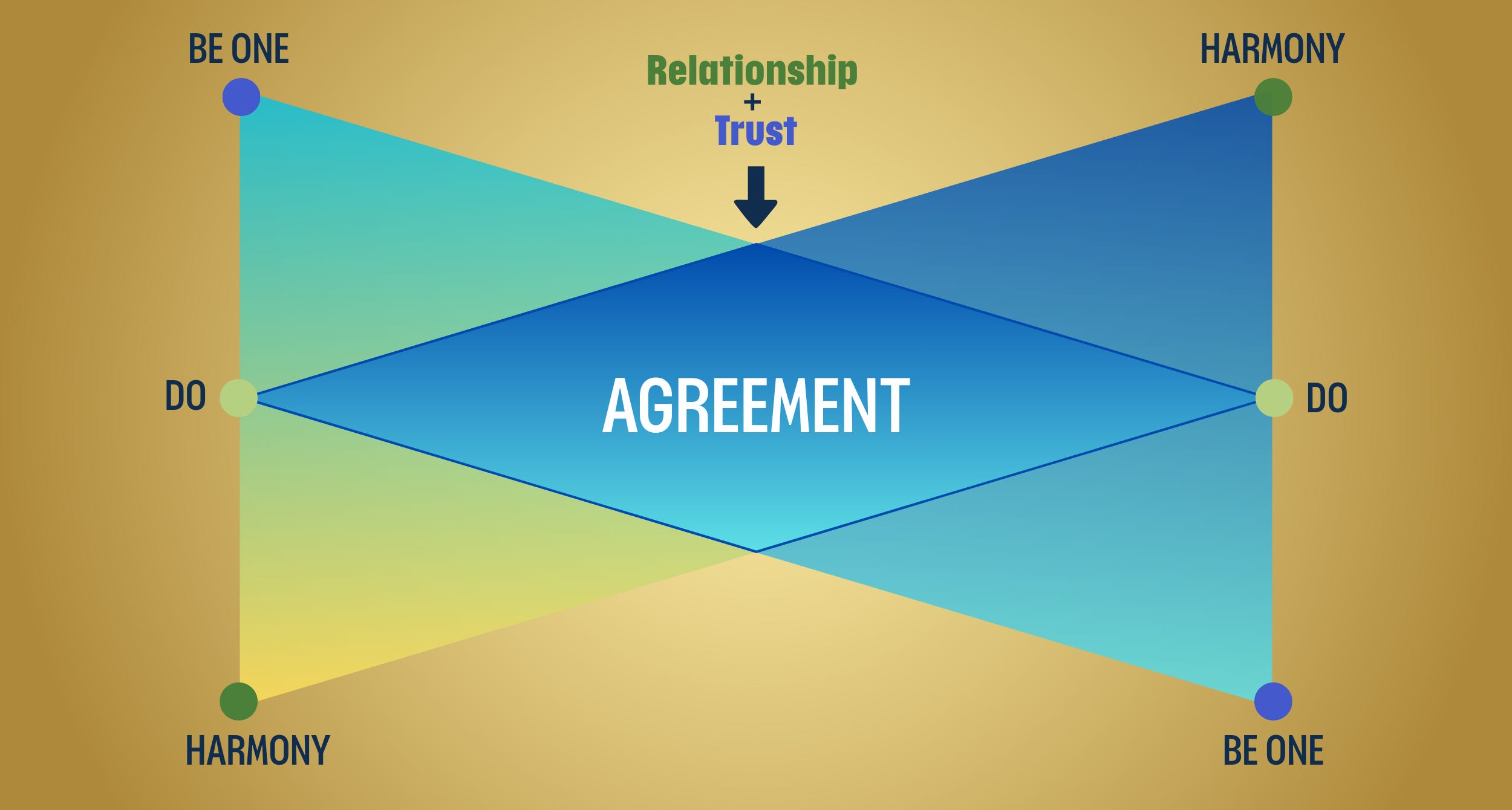
What people ask me the most about is the concept of Agreement. It’s surprising, really, because it’s such a simple thing. It’s something we all do day after day in all manner of situations. Yet, it’s something that has such depth and complexity that we never take even a moment to consider what manner of magic the simple act of Agreement represents.
To understand the “magic” in an Agreement, we have to start with the reason an Agreement can exist on any level. That reason is trust. But for trust to exist, there must be a relationship where trust can live. This seems to be just the simplest concept that anyone could possibly contemplate, but because there are at least two elements that do not seem to be connected, there is misunderstanding about why a relationship must be glued together with trust and what constitutes trust to begin with.
Trust is a pretty simple idea, too. Trust is nothing more or less than knowing that the folks in a relationship will be there in the relationship for a period of time. The amount of time that we know the folks in the relationship will be in the relationship is proportional to the trust we can afford to give. A given Agreement can then be, and usually is, a measure of the amount of time one or more of the parties to the agreement are willing to devote to the relationship the Agreement represents, and therefore the strength, or the depth, or the timeline of trust available in that relationship.
To illustrate this idea, let’s say that you meet someone at work. They’re a new person, but they live near you, and three days after they start work, your car breaks down. They hear about it and just come by your house to pick you up in the morning. What is the level of trust that you would extend to that new person? Wouldn’t it be greater than if you had asked if it would be too much trouble to give you a lift? See? You understand how Agreement works pretty well, huh?
Now let’s look at the other side of the equation. Let’s say that the new person had told you at work the day before you had to take your car to the shop that they would come by your house and pick you up. But the next morning, they don’t come by, and they don’t call, and you find out that they just went on to work without you.
How much trust would you have for them under those circumstances? Not much, huh?
Now, let’s start to look at why the trust is either extended or not to the new person. How important is the actual event of picking you up? Is that event what you see or measure when you consider the trust you extend to the new person in any of these examples, or do you consider how the new person extended respect to you as a person? The event of picking you up was important, but only because it measurably demonstrated the amount of time the new person was willing to place into the relationship and, therefore, the trust that was actually extended from both parties.
With the first example of the new person not even being asked, but coming to pick you up, the newbie communicated, not verbally mind you, that he liked you, that he was willing to go out of his way to include you in his life, that he didn’t need to be told what was necessary because he understood you and your needs, and that the level of trust was such that the time that would be invested in this relationship was more important than the mere inconvenience of the two of you getting to work.
But if you had asked if they would come to pick you up, you would have felt as though the relationship would always be strained because you would never know for sure if they came because you asked and they were new, or if they really liked you, or, or, or. The list of possible scenarios goes on and on, right?
However, if the new person didn’t show up and went on to work without you, then you’d never, ever be able to trust them again, huh? You would know from that point forward that every time the new person ever said anything or did anything, you would suspect them of lying. But why? Because they didn’t pick you up, or because they didn’t treat you as a person, that they felt you didn’t deserve even the effort of putting any time into a relationship with you?
Now, let’s look at a scenario with a different twist. Let’s say that you have planned a junket for the folks at work. Let’s say that you did most of the planning with the sales manager and the head of production at the plant where you work. Let’s say that this junket is in reality a training that would increase your company’s market share and that the sales manager and the production manager would profit directly from the educational material available on the junket.
Now, in order to even know what the educational material would be, you studied long and hard, looking at various educational models and pricing room and board and so on and so forth. You presented your findings at several meetings and laid out methods that your company could benefit from the education available. Now, you would certainly think that you would have the prerequisite trusting relationship with the sales manager and the production manager for them to help you pay for the junket out of their respective budgets, wouldn’t you?
But what if at the time of the junket, with reservations made and even paid for, one or both of them decided that they would not participate? If this junket had been in the planning stages for, let’s say, six months, and then they suddenly decided to not support you in your endeavor to help the company, how would you feel about the people involved in that decision? Would you, or even could you, simply forgive them their “change of heart?” Or would you have to begin to consider how you could remove them from the company?
This is a real dilemma, is it not? It is clear that the sales manager and the production manager have responsibility for their budgets, but it is also clear that they gave their word. They certainly have the right to change their minds, but there is a serious question about when they should have let you know that they had changed their mind, don’t you think? They had said they agreed with the plans you formulated and even helped you formulate the plans. But now they are saying they have simply changed their minds and that it was necessary.
If they had agreed to go on the junket and had partaken in the educational opportunity that existed as agreed, then the company would have, or at least should have, benefited both monetarily and in terms of morale. But because the two managers opted to not participate, then what damage is wrought in the company? Can there ever be trust in the two managers, even their own employees? Will the rift ever be repaired within the company?
Now it’s clear that these are made-up examples of Agreement, but I think they illustrate the basic understanding that we all have about how Agreements work. Agreements can be explained in terms of very basic Functions (Be One, Harmony and Do) which express through all of us, but in the end, there is a magic in Agreement that creates. What it creates depends entirely on the self-importance of the Agreement holders. If one Agreement holder is too important to worry about the feelings or even the trust that is due another Agreement holder, then the reality that will come of that Agreement cannot be pretty and most likely will not be advantageous. However, if all Agreement holders demonstrate the trust in the relationship that allows the Agreement to exist, then the reality which comes of such an Agreement is beneficial to all concerned.
Now that’s magic.
If you’ve enjoyed this post or found a good helping of food for thought, click “subscribe” to receive my weekly newsletter.
Thank you for your generous support. Please share and help spread the word!